For the busy PT
Seeing the same patient three times a week? No more re-reading what you already know. The summary is waiting when you open the chart.
Built by a PT for clinicians who actually see patients
Most AI scribes write the note after the visit. OmniScribeAI writes it duringthe visit — live, on the same screen where you can see it growing as you and your patient talk. By the time you say goodbye, you don't sit down to write a note. You sit down to review one. The transcript is captured. The draft is built. The CMS audit is already running. You walk out of the room with documentation that's minutes from done — not hours. This is what happens when a Doctor of Physical Therapy with 24 years of clinic experience builds the tool he wished existed for himself.

THE PRE-VISIT MOMENT
One screen. Today's encounter ready to capture. Last visit's summary already loaded. Previous notes one click away in a dropdown — so you can peek without leaving the page. Whether you're the one who saw the patient last time or you're covering for a colleague, you walk in informed instead of guessing.
Seeing the same patient three times a week? No more re-reading what you already know. The summary is waiting when you open the chart.
Full context on a patient you've never met, in five seconds. Initial eval, ADL baselines, treatment focus — surfaced automatically.
Every goal, every prior session focus, pulled forward without scrolling. Spend your time on the patient, not on chart archaeology.
This is the screen we wish every EHR had. So we built it.

LIVE EVERYTHING
The moment you hit record, three things start happening at once on the same screen. The transcription appears in real time, with every speaker labeled — you, the patient, the caregiver, the family member. The draft note builds itself live, growing section by section as the conversation unfolds. And the CMS compliance audit runs continuously in the background, flagging missing elements before you've even said goodbye. By the time the visit ends, you don't open a blank screen. You open a near-finished note with the audit already done.

Real-time transcription with speaker diarization. Every word captured as it's spoken. Every voice labeled — clinician, patient, family, caregiver — so you always know who said what when you review later.
Your draft note grows in real time as the conversation unfolds. Watch it populate live on the same screen as the transcript, or ignore it and focus on your patient — your call. Either way, when the visit ends, the draft is already there.
CMS compliance checks happen continuously, in the background, while the conversation is still going. Missing skilled need language? Weak medical necessity? Required elements not yet captured? You'll know before the patient walks out — not three hours later when you finally sit down to chart.
This is the difference between writing notes and reviewing notes. It's the difference between a 9 PM kitchen table and a 5 PM front door.
THE FEATURE NOBODY ELSE BUILT
Every other AI scribe forgets the patient the moment the visit ends. Rehab doesn't work like that. A patient on visit 14 of 20 isn't a one-off encounter — they're a journey. OmniScribeAI tracks that journey for you. It pulls forward goals from your initial eval, follows progression across every session, and writes progress notes that actually reflect the arc of care — not a disconnected snapshot.
BUILT FOR CLINICS, NOT JUST CLINICIANS
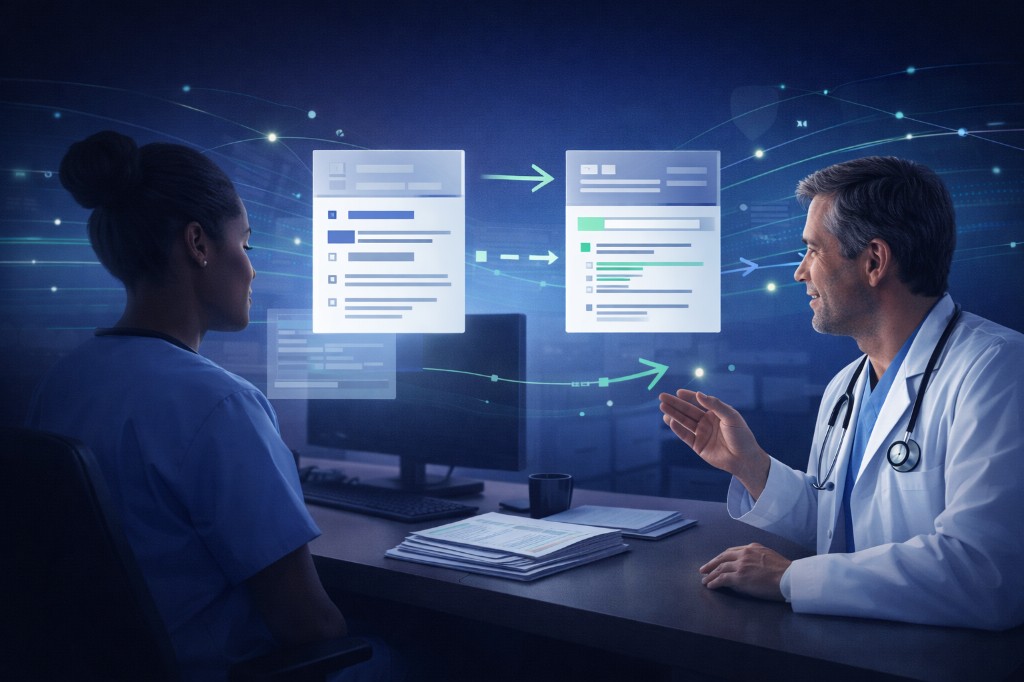
In a real clinic, no patient belongs to just one clinician. Vacations happen. Coverage happens. Schedules shift. Until now, that meant the next clinician walked in cold — flipping through prior notes, asking colleagues, guessing what worked. OmniScribeAI fixes that. Every clinician on your team sees the same patient context, the same goals, the same progression — within their own discipline, within their own department, within their own clinic. No silos. No handoff chaos. No patient ever feels like they're starting over.
Pick up where they left off, instantly. Every prior session, every goal, every cue that worked — already loaded when you open the patient. No texting your colleague at 7 AM to ask 'what's the deal with this one?'
When your team co-manages a patient, everyone sees the same picture. Initial eval, ADL baselines, current focus — synced across the team automatically. The patient gets continuity even when the therapist changes.
Goals set in the POC stay visible to every SLP on the team. Progression tracked across every session, by whoever sees the patient. The therapeutic plan moves forward — not in circles.
Department-scoped by design. PT notes stay with PT. OT notes stay with OT. SLP notes stay with SLP. Notes never cross between departments, between clinics, or outside your team. Every view is logged. Every access is auditable. HIPAA-aligned from the schema up — because the person who built this is a clinical director who actually gets audited.
The handoff problem isn't a software problem. It's a continuity problem. So we built for continuity.
THE TRUST ENGINE
Every AI scribe on the market asks you to trust it. OmniScribeAI does the opposite — it shows you exactly where to nottrust it, and tells you so before you sign. Lines pulled directly from the encounter are marked as direct evidence. Lines the AI inferred from context are flagged with a clear "review this" prompt. Nothing hides. Nothing pretends to be more certain than it is. You know which sentences came from the patient's mouth and which ones came from the AI's best guess — every single time.
Every line in your draft is tagged. Direct quotes from the encounter are marked as evidence-backed. Lines the AI inferred — from prior notes, clinical context, or pattern-matching — are flagged with a "review recommended" prompt right where they appear. You don't have to re-read the whole note hunting for problems. The note tells you where the risk is. You spend your review time on the lines that actually need it.
From the moment you start the encounter, OmniScribeAI runs a continuous audit against CMS documentation requirements for the encounter type — so by the time you're ready to sign, the compliance check is already done. Skilled need language. Medical necessity. Required elements for the note format. If something is missing or weak, you get a plain-language recommendation — not a cryptic error code — telling you exactly what to add or clarify. You sign with the same confidence you'd have if a compliance officer had pre-reviewed the note. Because, in effect, one just did.
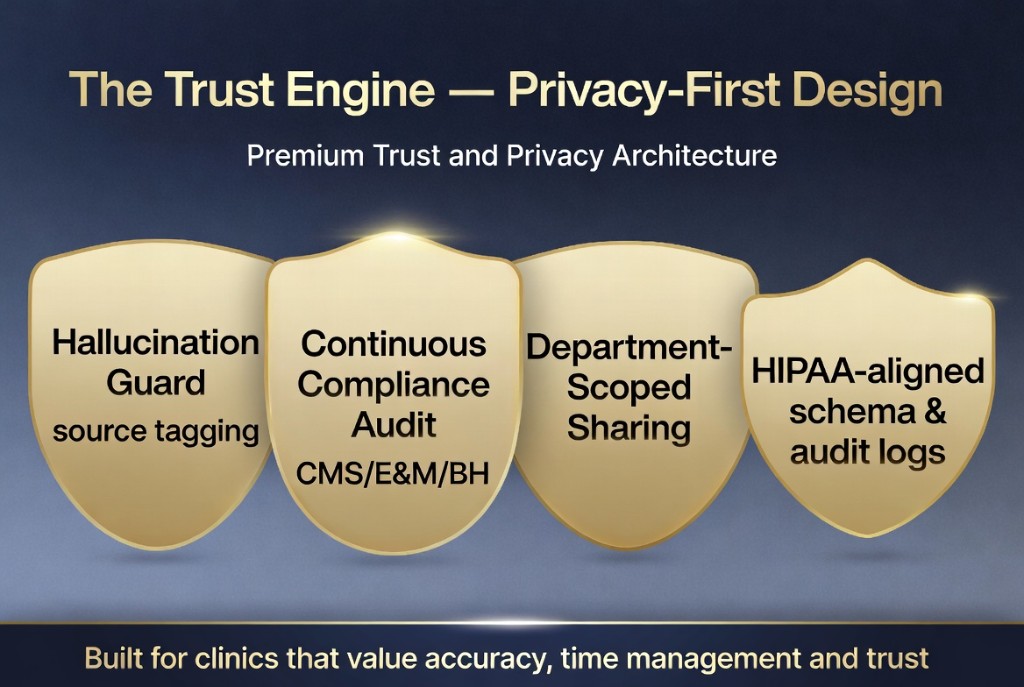
Every inferred line is flagged. Every CMS requirement is checked. Every recommendation is in plain language. You stay in control of every word — but you don't have to do the policing alone anymore.
Built by a clinical director who has lived through real audits. Designed for clinicians who'd rather sleep at night than wonder if a note will hold up.
WHY IT FEELS DIFFERENT
Most clinical software makes you hunt. Open the chart. Open the prior note. Open the goals tab. Open the documentation window. Switch back. Lose your place. OmniScribeAI puts the patient briefing, the prior note dropdown, the record button, the live transcript, and the draft note all on the same screen — because that's where your attention already is. You never have to ask "where do I click next?" The next thing you need is already in front of you.
Briefing, recording, prior notes, live transcript, and draft — all in one view. No tabs. No window-switching. No lost trains of thought.
The summary loads the moment you open the patient. No searching, no clicking, no waiting.
If it works after a 12-hour clinical day without extra clicks or tab-switching, it works for yours. This isn't software designed in a conference room. It's software designed by someone who needed it to survive clinic.
This is what intuitive looks like when the person designing it has actually had a bad clinic day.
BUILT BY A CLINICIAN WHO LIVED THIS
Twenty-four years in clinic. Thousands of evenings rebuilding sessions from memory at the kitchen table. Hundreds of mornings walking into rooms half-prepared because I didn't have time to re-read three prior notes. I knew the care I gave was good. I just couldn't always find the words fast enough — and I was tired of charting being the part of the job that broke me.
I'm also a clinical director. I run a physical therapy department inside a multi-service-line health clinic where we serve a tight-knit community. I know what it feels like to cover a colleague's patient and walk in blind. I know what it feels like to be the colleague handing off. I know what a real audit looks like, and I know the fear of signing a note that might not hold up. I built OmniScribeAI to fix all of it at once — for me, for my team, and for the patient who shouldn't have to repeat their story every time the schedule shifts.
OmniScribeAI is what happens when a clinician builds for clinicians instead of guessing what we need. If you've ever sat at your kitchen table at 9 PM finishing notes, this was built for you. If you've ever walked into a room and thought "wait, who is this again?" — this was built for you too. And if you've ever signed a note and immediately wondered if you should have re-read it one more time, this was built for you most of all.
— Founder, OmniScribeAI
Doctor of Physical Therapy · Clinical Director
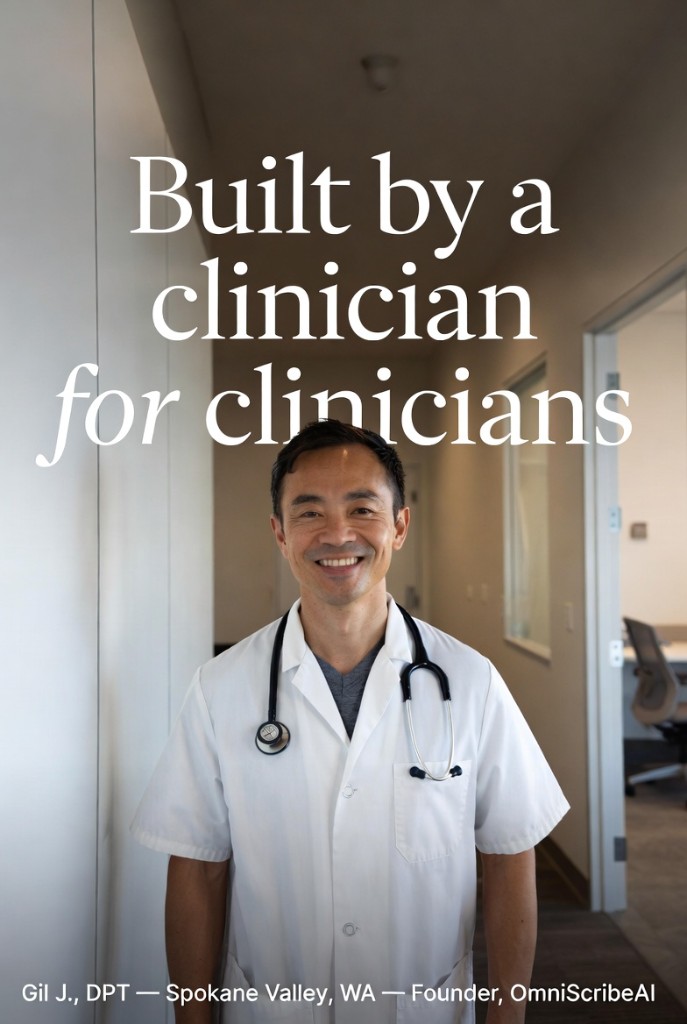
Two minutes to sign up. No credit card. Built by a clinician — and a clinical director — who spent too many nights at the kitchen table finishing notes, too many mornings walking into rooms blind, and too many late nights second-guessing a draft. So you don't have to.